
The Science Behind Three Tongues
Why learning three languages at once might actually help your brain.
Most people think we're slightly mad.
"Surely learning three languages at once is harder than learning one?"
That seems obvious... until you start thinking about how the brain actually learns.
Three Tongues was born from a simple observation.
The human brain isn't a filing cabinet. It doesn't remember things because somebody told it to. It remembers because it constantly searches for patterns.
Think about recognising faces.
Nobody teaches you how to recognise your best friend. Your brain quietly notices thousands of tiny patterns—eyes, smile, voice, movement—until recognition becomes effortless.
Language may work in a surprisingly similar way.
Your Brain Is a Pattern Machine
Over the last twenty years, researchers have increasingly recognised the importance of statistical learning—our brain's remarkable ability to detect patterns without conscious effort.
Even babies begin finding repeated sound combinations long before they understand grammar.
They don't memorise rules.
They discover patterns.
The same process continues throughout life.
Every time we hear "Gracias", "Merci", "Obrigado" or "Danke", our brain begins quietly building connections.
The more patterns it notices...
...the easier recognition becomes.
Why Three Languages?
This is where Three Tongues takes a slightly different path.
Traditional language apps usually teach one language at a time.
We wondered...
What if comparing three languages actually helps the brain notice differences and similarities more quickly?
Imagine hearing:
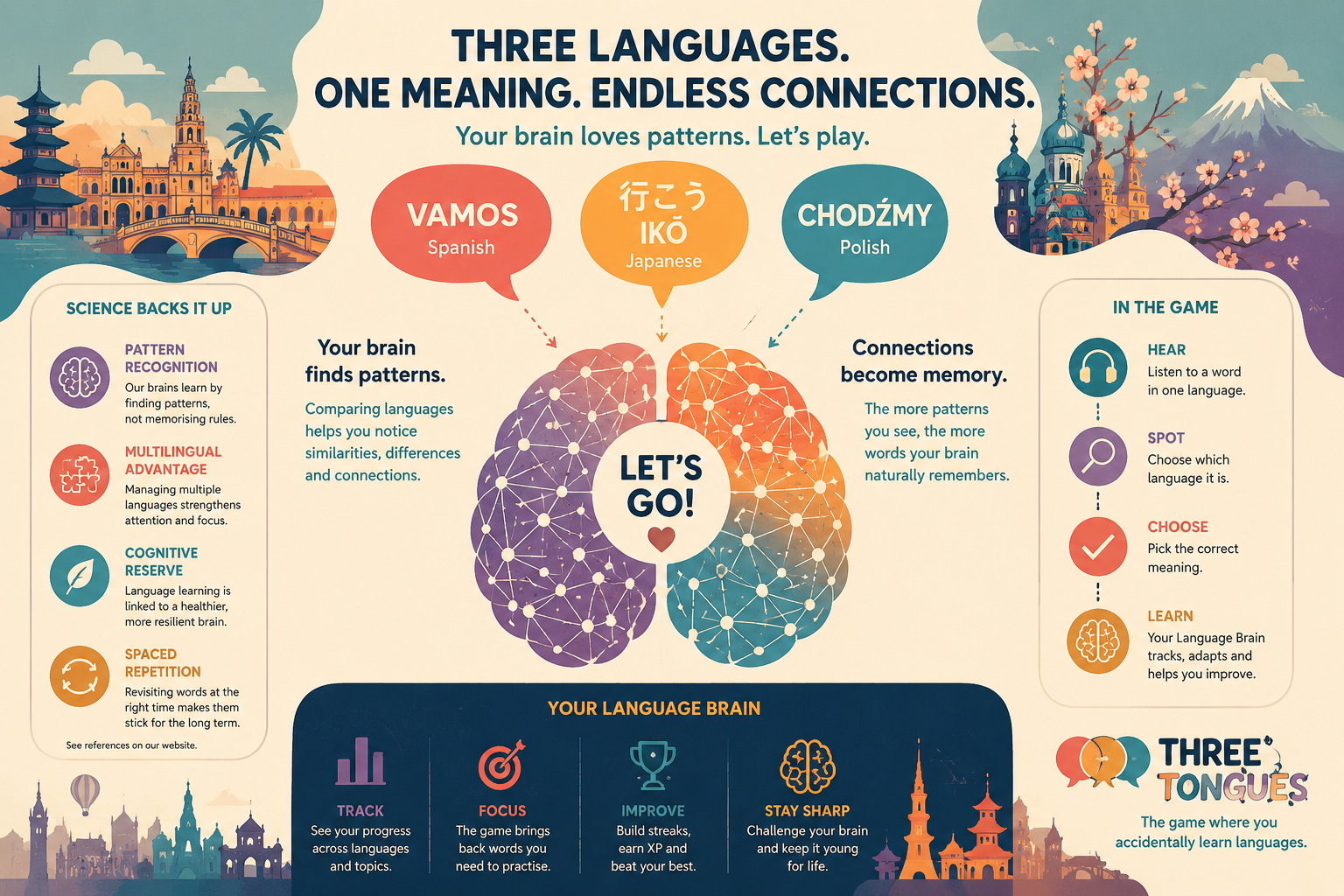
- VamosSpanish
- IkōJapanese
- ChodźmyPolish
All three mean exactly the same thing:
Let's go!
Instead of storing one isolated word, your brain begins building a small network.
Three different sounds.
One meaning.
That comparison itself may become the memory.
We call this Triangulated Language Learning.
It's our own name for the idea that comparing multiple languages encourages the brain to build richer mental connections rather than isolated vocabulary lists.
The Multilingual Brain Is Always Comparing
Research has shown something fascinating.
People who know more than one language don't simply switch one language off and another on.
Their languages remain active together.
The brain constantly manages, compares and selects between competing language systems.
Even when reading or listening in just one language, the others can still be quietly active in the background.
In other words...
The multilingual brain is already doing something very similar to what Three Tongues asks players to do.
Listen.
Compare.
Recognise.
Choose.
Practice Without Feeling Like Study
One of the biggest challenges in language learning isn't grammar.
It's motivation.
Many people start enthusiastically...
...then slowly drift away.
Games work differently.
You play because it's enjoyable.
Learning becomes the side effect.
That's exactly the philosophy behind Three Tongues.
First it's a puzzle.
Then it's a habit.
Then, one day, you suddenly realise you know dozens—or even hundreds—of words you never consciously tried to memorise.
Your Brain Loves Revisiting Mistakes
Three Tongues is beginning to do something else that excites us.
If you miss a word...
...it quietly comes back later.
Not immediately.
Not annoyingly.
Just enough time later for your brain to have almost forgotten it.
Educational psychology has long shown that spacing out repeated encounters with information strengthens long-term memory far better than simple repetition.
We're now building this idea directly into the game.
Eventually every player will have their own Language Brain.
The game will remember which words you've mastered...
...which ones you're still learning...
...and which ones need another gentle nudge.
Instead of everybody following the same path...
...the game slowly becomes personalised.
Keeping Your Brain Busy
Researchers continue to debate exactly how multilingualism influences cognitive performance and healthy ageing.
Some studies suggest benefits for attention, cognitive control and cognitive reserve, while others report smaller or more variable effects depending on language experience and methodology.
What almost everyone agrees on is this:
The brain remains adaptable throughout life.
Learning, comparing, switching attention and recognising patterns all provide meaningful mental exercise.
Whether you're 16 or 76...
Keeping your brain active is never a bad investment.
An Experiment Worth Playing
Three Tongues isn't trying to replace traditional language learning.
We're exploring a different question.
What happens if language learning feels more like Wordle than homework?
Can comparing three languages help your brain discover patterns that one language alone might hide?
We're still learning ourselves.
Every player who joins us is helping answer that question.
Perhaps the most exciting thing about Three Tongues isn't simply learning another language.
It's discovering what your own brain is capable of when you let it do what it does best...
Find patterns.
Further Reading
- Statistical Learning and Language Acquisition
One of the classic reviews explaining how the brain automatically detects patterns in speech and language without conscious memorisation.
https://pmc.ncbi.nlm.nih.gov/articles/PMC3112001/ - Statistical Learning of Language: A Meta-analysis into 25 Years of Research
A comprehensive review covering hundreds of experiments.
https://onlinelibrary.wiley.com/doi/full/10.1111/cogs.13198 - Second Language Experience Facilitates Statistical Learning
Does learning another language improve your brain's ability to detect patterns?
https://pmc.ncbi.nlm.nih.gov/articles/PMC5407950/ - The Contributions of Implicit Statistical Learning to Second Language Knowledge
Excellent paper on pattern detection and intuitive language learning.
https://www.cambridge.org/core/journals/studies-in-second-language-acquisition/article/contributions-of-implicitstatistical-learning-aptitude-to-implicit-secondlanguage-knowledge/30B6EC0CBFD1B1DA2E8963C9A8C78B12 - Bilingualism: Pathway to Cognitive Reserve (Ellen Bialystok)
One of the leading researchers on bilingualism discusses cognitive reserve.
https://pubmed.ncbi.nlm.nih.gov/33771449/ - Does Bilingualism Influence Cognitive Aging?
Long-term study examining bilingualism and later-life cognition.
https://pmc.ncbi.nlm.nih.gov/articles/PMC4320748/ - Multilingualism and Cognitive Reserve
Chapter from The Cambridge Handbook of Third Language Acquisition.
https://www.cambridge.org/core/books/cambridge-handbook-of-third-language-acquisition/multilingualism-and-cognitive-reserve/FC9D0AAED7C4138C5A292792AA9A0810 - Bilingualism and Aging: Implications for Delaying Dementia
Balanced review of the evidence and debate.
https://pmc.ncbi.nlm.nih.gov/articles/PMC8847162/ - The Association Between Multilingual Experience and Cognitive Function
Recent research into multilingualism and healthy ageing.
https://pmc.ncbi.nlm.nih.gov/articles/PMC11815170/ - Bilingualism: Language and Cognition (Cambridge Journal)
A leading academic journal dedicated to multilingualism and language learning.
https://www.cambridge.org/core/journals/bilingualism-language-and-cognition
Ready to play?
Spot the language. Choose the meaning. See what your brain remembers.
Play Three Tongues